On this page
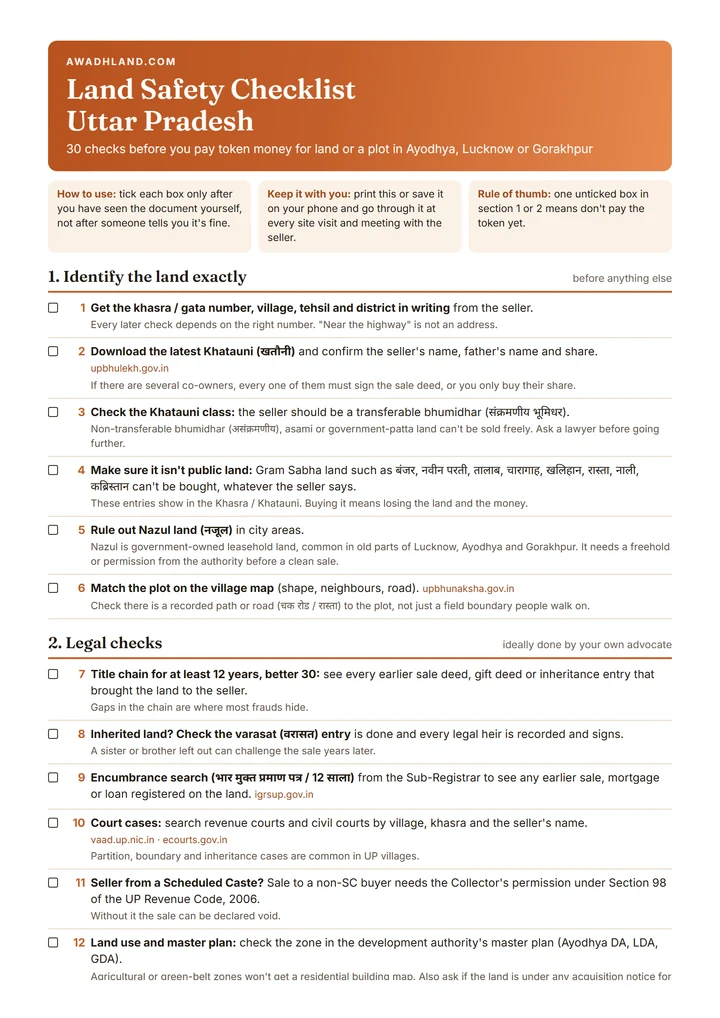
3 pages · A4 · no sign-up · Open to print
Want us to check a plot for you? WhatsApp us the khasra number.
WhatsApp us the khasra numberMost land disputes in UP start with something a buyer could have checked before paying the token: a khasra number that does not match the plot, a co-owner who never signed, Gram Sabha land sold as private, or a power-of-attorney "sale" that never transferred ownership. This checklist puts those checks in order.
It has 30 checks in five stages: identifying the land, the legal checks, the site visit, the money and the registry, and what to do after it. Tick a box only after you have seen the document yourself, not after someone tells you it is fine. One unticked box in stage 1 or 2 means don't pay the token yet.
1. Identify the land exactly
before anything else
Get the khasra / gata number, village, tehsil and district in writing from the seller.
Every later check depends on the right number. "Near the highway" is not an address.
Download the latest Khatauni (खतौनी) and confirm the seller's name, father's name and share.upbhulekh.gov.in
If there are several co-owners, every one of them must sign the sale deed, or you only buy their share.
Check the Khatauni class: the seller should be a transferable bhumidhar (संक्रमणीय भूमिधर).
Non-transferable bhumidhar (असंक्रमणीय), asami or government-patta land can't be sold freely. Ask a lawyer before going further.
Make sure it isn't public land: Gram Sabha land such as बंजर, नवीन परती, तालाब, चारागाह, खलिहान, रास्ता, नाली, कब्रिस्तान can't be bought, whatever the seller says.
These entries show in the Khasra / Khatauni. Buying it means losing the land and the money.
Rule out Nazul land (नजूल) in city areas.
Nazul is government-owned leasehold land, common in old parts of Lucknow, Ayodhya and Gorakhpur. It needs a freehold or permission from the authority before a clean sale.
Match the plot on the village map (shape, neighbours, road).upbhunaksha.gov.in
Check there is a recorded path or road (चक रोड / रास्ता) to the plot, not just a field boundary people walk on.
2. Legal checks
ideally done by your own advocate
Title chain for at least 12 years, better 30: see every earlier sale deed, gift deed or inheritance entry that brought the land to the seller.
Gaps in the chain are where most frauds hide.
Inherited land? Check the varasat (वरासत) entry is done and every legal heir is recorded and signs.
A sister or brother left out can challenge the sale years later.
Encumbrance search (भार मुक्त प्रमाण पत्र / 12 साला) from the Sub-Registrar to see any earlier sale, mortgage or loan registered on the land.igrsup.gov.in
Court cases: search revenue courts and civil courts by village, khasra and the seller's name.vaad.up.nic.inecourts.gov.in
Partition, boundary and inheritance cases are common in UP villages.
Seller from a Scheduled Caste? Sale to a non-SC buyer needs the Collector's permission under Section 98 of the UP Revenue Code, 2006.
Without it the sale can be declared void.
Land use and master plan: check the zone in the development authority's master plan (Ayodhya DA, LDA, GDA).
Agricultural or green-belt zones won't get a residential building map. Also ask if the land is under any acquisition notice for a highway, ring road or airport.
Buying farmland to build on? Ask whether the Section 80 declaration (non-agricultural use) has been done by the SDM, or budget time and cost to get it.
Plot in a colony or layout? Check it is registered with UP RERA (where required) and the layout is approved by the development authority.up-rera.in
Unapproved colonies often can't get a building map, water or electricity connections on normal terms.
NRI or OCI buyer? Under FEMA you can't buy agricultural land, a plantation or a farmhouse. Residential and commercial plots are allowed.
Inheritance is a separate case. Take advice before paying.
3. Site visit
go yourself, or send someone you trust
Stand on the plot and check the boundaries against the map and the deed: length, width, neighbours on each side.
Talk to two or three neighbours: who owns it, who farms it, any dispute?
They know things no record shows.
Check who is in possession. Crops, a hut or a tenant on the land means someone else claims a right to it.
Get a measurement (पैमाइश) by the Lekhpal before the registry, especially for part of a larger khasra.
Look at the ground itself: low-lying or flood-prone near a river (Saryu, Gomti, Rapti, Rohin), high-tension lines overhead, drains, waterlogging in monsoon.
4. Money and registry
where most people lose money
Sign an agreement to sell before the token with price, area, khasra, timeline and a full refund clause if the title fails.
A registered agreement is stronger.
Pay only by bank transfer, cheque or DD. Cash advances of ₹20,000 or more for land, or taking ₹2 lakh or more in cash, are not allowed under the Income Tax Act.
Bank records are also your proof of payment.
Check the circle rate. Stamp duty is charged on the circle-rate value or the deal price, whichever is higher.Circle rate lookup
A price far below the circle rate is a warning sign, not a bargain.
TDS: if the price is ₹50 lakh or more (and it isn't rural farmland), deduct 1% TDS and deposit it. Different rules apply if the seller is an NRI.
Ask your CA.
See the originals of all earlier deeds, and match the seller's Aadhaar and PAN with the Khatauni name.
Avoid power-of-attorney "sales". The Supreme Court has held that a sale through GPA, agreement or will doesn't transfer ownership.
Buy only through a registered sale deed (बैनामा) signed by the recorded owner.
Registry at the Sub-Registrar office with the seller in person, two witnesses, and the deed matching the khasra, area and boundaries you checked.
5. After the registry
don't stop here
Mutation (दाखिल-खारिज) at the tehsil: follow up until the Khatauni shows your name.
Until then, records still show the seller as owner.
Keep a file: certified copy of the sale deed, new Khatauni, map, payment proofs, receipts for stamp duty.
Protect the plot: put up a boundary or at least pillars and a board with your name, and visit it regularly.
Red flags: walk away or slow down
- The seller is in a hurry, or the price is well below nearby deals and the circle rate.
- Only photocopies, no originals. "The registry will happen later."
- A power-of-attorney holder is selling instead of the owner.
- The name in the Khatauni doesn't match the seller's ID, or some co-owners are "not available".
- The plot is "right next to" a big government project, but no one can show the master-plan zone.
- You're asked to pay cash, or into someone else's account.
Documents to collect
Tick each one as you receive it, and keep them together in one file.
- Latest Khatauni (खतौनी)
- Khasra / village map extract (भू-नक्शा)
- Earlier sale / gift deeds (12–30 years)
- Varasat entry, if inherited
- Encumbrance search (भार मुक्त प्रमाण पत्र)
- Court case search results
- Master-plan zone / layout approval
- RERA registration (colony plots)
- Section 80 order (if farmland for building)
- Seller ID: Aadhaar + PAN
- Agreement to sell + payment proofs
- Registered sale deed + mutation order
This checklist is general information for buyers in Uttar Pradesh, not legal or tax advice. Rules and portals change; always have an advocate verify the title and a chartered accountant confirm tax before you pay.
By
Awadhland editorial
Written and checked by the site's editorial team at Stringhead Technologies, Pune. Every rate and distance quoted comes from the data pages, with a source and a date.